
A technical vision is the compass of an engineering organization. It sets the long-term direction. I believe it should define the "why" and "where" behind the technical choices that would follow. At its core, a technical vision should answer three questions. What outcome do we want to achieve? By when? And through which actions will we get there? Without those anchors, a vision becomes just a few slogans. With them, it becomes a living guide that can outlast reorganizations, leadership changes, and even technology shifts.
I think strong technical visions tend to focus on a few recurring themes. These include increasing the reliability of services, reducing toil for teams, enabling large scale changes, and fostering collaboration across silos. For example, a goal might be to migrate all on premise infrastructure to the cloud by a fixed year. Another might be to reshape how engineering and product teams share accountability. Both kinds of goals matter. What unites them is that they are measurable, time-bound, and actionable. A good vision never hides behind vague aspirations. It translates directly into outcomes and key results.
In my opinion, the most important point is that a technical vision is not written in isolation. No single architect, manager, or CTO can produce a vision that works simply by publishing it. To succeed, it must be built collaboratively. You can’t just have one person to do it. Engineers must see their pain points reflected in it. Managers must see how it reduces risk and unlocks scale. Stakeholders must feel confident that the vision aligns with business priorities. Buy-in is the only way to ensure the vision survives contact with reality. I tried the other way around. It simply doesn’t work. The best way I have seen is divide and conquer: get people to be part of the process, and then discuss each item together.
You also need to remind yourself and people involved that a technical vision is an evolutionary cycle. It runs through three interlocking phases. We analyze the present to understand the assumptions and systems that got us here. We align across roles and teams to ensure goals feel inevitable rather than imposed. And then we execute. We turn principles into practice while measuring, learning, and adjusting along the way. When execution ends, the cycle does not close. It loops back to analysis. It is ready to start again with new data, new challenges, and new opportunities.
In my experience, the visions that endure are the ones that do not just describe technology. They embed themselves into the culture through principles and habits. "Own what you build." "Optimize for clarity before speed." These kinds of principles carry the vision forward. This happens even when leaders move on or strategies shift. A real technical vision is not a glossy document. It is a shared mindset, a set of values, and a cycle of continuous improvement.
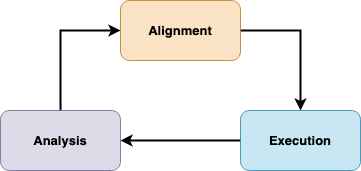 Technical vision cycle
Technical Vision Cycle
Analysis
Every cycle of a technical vision starts with the current reality. We need to understand the history behind past decisions. Most engineering teams make these decisions based on the facts they had at the time. Technology and business constantly change. Assumptions that were valid two years ago might not be anymore.
To position ourselves for the future, we must analyze the technology. We need to see how it serves stakeholders from multiple angles. We must identify gaps between the technology and the future direction. The analysis will dive into many areas. These include incidents, scalability, data processing, quality, self-service, and development processes. Each of these pillars will influence the technical vision. They can each become a goal to achieve.
Over the years, I've found that the hardest part of analysis is beyond dashboards or incident reports. You must uncover assumptions that teams quietly live with. Often, the technology is doing what it was built to do. But the business, the people, or the scale have outgrown it. I've seen teams hold onto two-year-old decisions because "that's how we've always done it." This happens even when the landscape has shifted. That's why I pair metrics and postmortems with conversations. I ask engineers what slows them down. I ask stakeholders what feels fragile. I ask myself whether our stack serves tomorrow as well as today. The answers usually reveal gaps no graph could.
Let’s think about the analysis of a travel search platform. Let’s imagine it’s grappling with a systemic misalignment between technology, process, and strategy.
The Quantitative Signals
- Time-to-Market for New Partners: Average onboarding takes three months. Dashboards tracking “new provider integration” show a backlog that has doubled year over year. Competitors achieve integrations in 4–6 weeks, creating a visible revenue gap.
- Release Frequency & Stability: Deployment metrics show releases occur only every 2–4 weeks, with a 25–30% rollback rate. Dashboards highlight spikes in failed builds and post-release incidents.
- Customer Reliability: Incident dashboards show recurring latency spikes during peak travel periods, doubling booking abandonment rates. Uptime charts trend downward around holidays, correlating with seven-figure seasonal revenue losses.
The Qualitative Signals
- Engineering Teams: Engineers explain that the monolithic architecture is a brittle, tightly coupled codebase. A change in the search algorithm can break payment flows. They admit technical debt was deliberately ignored during rapid growth years. Now, every line of code feels like a liability. You hear “We don’t innovate. We just babysit the system,” one engineer puts it.
- Product Managers: Product conversations reveal deep frustration. “We can’t even prototype without risking production,” a PM explains.
- Business Development: Business leaders voice direct revenue pain. “We’ve lost three airlines this year alone because we couldn’t commit to an integration timeline”.
The Organizational Signals
- Architectural Gap: Dashboards show high system fragility, while engineers describe the monolith as a “single point of failure.” Architecture is constraining the whole organization.
- Strategic Gap: Commercial dashboards highlight lost deals. Conversations reveal strategy and technical capability are fundamentally misaligned. Leadership bets on rapid growth while the platform enforces slowness.
- Process Gap: There is no governance framework for technical debt. Dashboards show feature delivery slowing, but leaders continue to push new features without structural fixes.
- Organizational Gap: Attrition metrics rise in engineering. Conversations reveal eroding trust: product sees engineering as a blocker, engineering feels product is unrealistic, and business feels unsupported. Culture itself is trending negatively.
The Interplay of Signals
Metrics and dashboards tell the story of slow integration, fragile releases, and customer pain. We uncover invisible assumptions: that firefighting is normal, that six-month integrations are just how it is. That strategy can outpace infrastructure. We can only diagnose full organizational level problems by combining quantitative signals with qualitative ones.
When we’ve uncovered architectural bottlenecks, misaligned strategies, and silent assumptions during analysis, we now have the raw material for a technical vision. But those findings need to be translated into clear, actionable goals that the organization can rally around. Without alignment, analysis remains a list of complaints. With alignment, it becomes the foundation for transformation.
Alignment
Once we have gone through the archaeology of technical direction, we can start forming the goals and vision for the future. Technical vision isn’t just about preparing the company or organization for future growth from a technical perspective. Building a technical roadmap might require downsizing before growing again. The technical vision should address not only growing pains but also house cleaning. The vision would attack many concerns and come up with actionable and applicable goals. A good goal is simple enough so that it captures essentials. Yet, it gives room for implementation. Here are a couple of examples of goals.
Architectural Goal
This has to be company or organization wide. We will transition from a monolithic architecture to a microservices architecture.
- Our immediate focus is on re-architecting the search and booking services to enable independent scalability.
- By the end of Q4 2026, 60% of our customer transactions will run on the new service-based architecture, reducing our site-wide downtime during peak periods by 80%.
Strategic Goal
We will establish a continuous technical readiness program. This program will synchronize product roadmaps with our platform capabilities.
- Every new commercial partnership proposal must now include a technical feasibility review and be signed off by a lead engineer.
- By the end of 2024, we will reduce partner onboarding time from 3 months to 2 weeks.
Process Goal
This has to be an engineering wide goal. One team implementing in isolation won’t return massive results.
- We will operationalize technical debt management. We will dedicate a minimum of 25% of engineering time each sprint to addressing technical debt.
- Each team will maintain a visible technical debt backlog that is reviewed and prioritized biweekly. By 2025, we will reduce the number of critical production incidents by 50%.
Cultural Goal
This has to be cross functional. Here’s an example
- We will create a shared sense of ownership and accountability. We will establish cross-functional pods for key initiatives. These pods will include members from Engineering, Product, and Business Development.
- All quarterly objectives will now include at least one cross-team key result tied to the platform's scalability or reliability.
Coming up with exciting goals is a refresher. Nevertheless, stakeholders shouldn’t hear them in announcement meetings. Stakeholders should be part of the process to come up with these goals and align their vision with ours. There’s also no way to get everything right at once. Therefore, the technical vision should be a live document. We should realign and socialize it as we see fit. After the initial announcement, the company or organization should work towards implementing the vision.
In my own experience, alignment only works if people see themselves in the vision. I’ve been in organizations where leadership set ambitious goals but just fluff. Obviously, it got nowhere. What worked better was bringing people into the process early. I remember mapping out ownership boundaries with engineers, product managers, and ops leads all in the same room. It was messy at first, but when everyone left, they didn’t just understand the goals. Everyone owned their piece. That ownership made all the difference, because alignment isn’t about forcing consensus; it’s about making sure the vision feels inevitable to the people doing the work.
Execution
When the technical vision is ready, the organization moves into execution. Execution means weaving the architectural, strategic, process, and cultural goals into both short term and long term planning. Teams align their own objectives with these broader goals and begin with the first concrete steps.
For example, the architectural goal comes to life by starting with the search and booking services. The first step is to decouple these flows so they can scale independently. Progress can be measured by the reduction in regression failures and by the percentage of customer transactions running on the new service-based architecture.
The strategic goal shows up in how new commercial partnerships are handled. Every proposal now requires a technical feasibility review and the sign-off of a lead engineer. The impact can be tracked directly in the onboarding metric. The target is to bring the integration time down from three months to two weeks.
The process goal becomes real when teams dedicate time to technical debt. Each sprint now reserves a portion of capacity for addressing debt. Teams keep a visible backlog and review it biweekly. Success is not vague. It is measured by the drop in critical production incidents and the faster delivery of features.
The cultural goal is executed through cross functional pods. These pods bring together engineering, product, and business development around key initiatives. Ownership is shared and accountability is written into quarterly objectives. Progress is visible when cross team OKRs tie directly to platform scalability and reliability.
Execution is never simple. But management needs to ensure it takes place. After each step, we measure, reflect, and adjust. Sometimes the results are positive. Other times the improvement is smaller than expected. When that happens, we treat it as a signal to try something else. What matters most is the feedback loop. The teams that thrive are the ones that measure honestly, learn quickly, and are not afraid to change direction.
From my own experience, the projects that succeed are the ones that embed feedback loops into the work. I remember introducing auto scaling for a service. We believed it would be a big leap in reliability. The improvement turned out to be smaller than we hoped. Instead of forcing it, we took it as a signal to look elsewhere. That shift uncovered bigger opportunities we had missed. Execution is not about being right the first time. It is about learning, adjusting, and eventually getting it right.
Conclusion
A technical vision is a tool to analyze, align, and execute long term technical goals for teams and organizations. In the analysis stage, we look at our stack and uncover what is broken or holding us back. In the alignment stage, we work with stakeholders to define the goals and make sure they are shared. Then we communicate these goals across the organization. In the execution stage, we turn those goals into plans, act on them, and measure the outcomes. We gather the lessons and feed them back into the next cycle. A technical vision is not a one time effort. It is a cycle that continues for as long as the company exists.
What I have learned is that sustaining a vision cannot depend on a single leader or a single team. I have seen visions collapse the moment a key person left, because nothing had been embedded into the culture. The visions that endure are the ones grounded in simple principles that everyone can carry with them. That is why companies like Amazon lean on principles such as “own what you build” or “optimize for clarity before speed.” These values outlive reorganizations and leadership changes. They keep the direction steady even when strategies shift. To me, a real technical vision is not a glossy document. It is a shared set of habits and values that survive disruption and keep moving the organization forward.