
It was during my college years that I saw the Big Lebowski for the first time. Within days, my friends and I were calling each other “dude”. Living in Turkey, despite English-speaking classes, the word “dude” entered our lives because of this movie. Even now, wherever someone asks: what’s the big deal with the Big Lebowski? A part of me still thinks — yeah, well, that’s just like your opinion, man.
It is what I call a men’s movie. Back then, we loved it because it was hilarious. A bunch of nobodies are thrown into what feels like some grand mission, and they fail their way through it, only to lose their beloved friend in the process. There was something deeply funny about how seriously everything was framed, even though these people were so completely unequipped for it. Maybe that is also why it fits college so well. That whole mix of failure, aimlessness, and male absurdity really tied the dorm room together.
Over the years, I watched the movie again and again. And as I did, I started noticing patterns. That made me like it even more. In this post, I want to go through some of them.
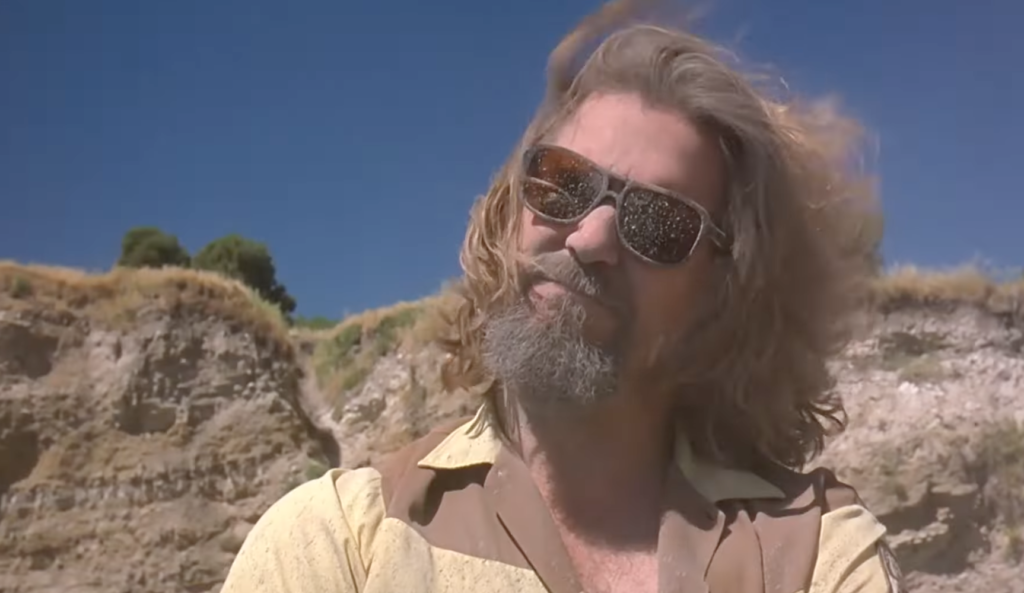 The Dude's ash-scattering scene in The Big Lebowski
Why It Is Funny
At first, what grabs you is the humor. The film is full of absurd lines, ridiculous misunderstandings, and characters who speak with complete confidence while having very little idea what is actually going on.
The thing that makes the humor work is that everyone behaves as if they are in a much bigger movie than the one they are actually in. They speak as if history depends on them. They react as if every tiny inconvenience is part of some epic conflict. But in reality, half the time they are arguing about nonsense, making things worse, or simply not understanding what is happening. What I loved back then, maybe without fully knowing why, was exactly that. They are nobodies, yet the film frames them as if they are caught in something grand.
The Plot
There is a kidnapping, a ransom, rich people, pornographers, nihilists, bowling rivals, and all kinds of suspicious side characters. Yet somehow, the plot keeps slipping through your fingers. You think you are following it, and then it becomes clear that the film is not really interested in solving anything in the usual satisfying way.
That is part of why it stays so fresh on rewatch. The first time, you are trying to understand what happened. Later, you stop caring so much about solving it. You start paying more attention to how people behave while things are happening around them.
The dude himself barely resembles a normal protagonist. He does not feel driven by ambition, revenge, or even curiosity in the way movie heroes usually are. He mostly wants his rug back, and even that desire somehow gets swallowed by the madness around him.
Weird Character Mix
Another thing I noticed more over time is that the movie is full of people who seem to belong to different films. Walter is operating with the intensity of a war movie. The Big Lebowski behaves like he belongs to some grand American success story. Maude seems to come from an entirely different intellectual and artistic universe. The nihilists are just a complete randomness.
Somehow all of this should fall apart, but instead it creates the strange charm of the film. This is also why the world of the movie feels larger than the actual events. You get the sense that each character carries an entire mythology around with them, but the film only lets you see pieces of it. That makes even side characters memorable. Jesus, for example, barely matters to the main plot, yet no one forgets him. 8-year olds. The same goes for Maude, for Jackie Treehorn. They all feel strangely complete, even when the movie refuses to explain them fully.
It is not Just a Joke
Everyone around the dude is trying to perform something. Authority, masculinity, intellect, toughness, wealth, danger, importance. The dude, oddly enough, performs less than anyone. He is not impressive. He is not forceful. He is not even particularly competent. Yet he feels more real than most of the people around him.
That may be why the character had such a long afterlife outside the film. The dude abides rather than trying to control everything around him. We can all take a page from his book. I do not think you need to turn the movie into a philosophy lecture to feel that. It is enough to notice that he survives the madness without becoming monstrous, pompous, or fake.
The Failure of Men
There is another layer to the movie that only started to make sense to me much later. Almost every male character in The Big Lebowski is, in some way, a failed version of what he thinks he should be.
The dude is supposed to be free, independent, maybe even a kind of anti-system thinker. In reality, he has no real direction, no responsibility, no structure. Walter is supposed to be strong, disciplined, a man shaped by war. Instead, he is unstable, reactive, constantly overcompensating. The big Lebowski presents himself as a successful, self-made man, but underneath that image he is hollow, dependent, and performative. Even the nihilists, who claim they believe in nothing, are still chasing money and acting tough in a way that feels almost childish.
You see men who talk about strength but cannot control themselves. Men who talk about success but are completely dependent on others. Men who claim to reject the system but have nothing meaningful to replace it with. Men who drift, postpone, avoid, and somehow wake up years later still in the same place.
At a younger age, it is easy to laugh at that. You think failing is temporary. You think people will eventually figure things out. You think getting back up is the default. At a certain age, you see that’s not the case. Many people do not get back up. They adapt to failure. They normalize it. They build an identity around it. And slowly, without any dramatic moment, they become what the movie shows so well: a group of nobodies, still talking, still moving, still pretending things are under control.
The movie does not present a clean alternative either. It does not show a better man who has figured everything out. Instead, it places all these versions next to each other and lets them collide. The aggressive man fails. The successful man fails. The philosophical man fails. The passive man survives. At some point, it starts looking like a mirror. All I have to say is every man fails but just in a different way. And yet, for all that grand failure, the movie begins with something almost embarrassingly small.
The Rug
Someone breaks into your house, confuses you with someone else, and pees on your rug. And somehow, that becomes the reason everything starts. Because the rug is the only thing in the entire movie that the dude actually cares about. He does not care about the money. He does not care about the kidnapping. He barely cares about the truth of what is happening. The rug matters. It made his space feel right. And once it is gone, everything feels slightly off.
That is what makes it interesting. The whole movie pretends to be about something big, a ransom, a missing woman, powerful people, danger. But at its core, it starts with something small and personal. A disruption of a very specific kind of order.
And that makes the whole thing feel strangely familiar. Because in real life, it is often not the big things that throw you off. It is the small ones. The routine that breaks. The one thing that kept your environment stable. The quiet sense that your space, your life, your habits were somehow holding together, and then suddenly they are not.
You tell yourself it is nothing. It is just a rug. But it is not. It is the difference between things feeling right and things feeling slightly wrong. And once that feeling is gone, everything else becomes harder to ignore.
The Fear of Losing
There is a pattern in the movie that feels almost excessive at first. The constant references to castration. People threaten to cut off someone’s Johnson. There are jokes, metaphors, dream sequences with giant scissors. It shows up again and again, almost to the point where it feels like the movie is overdoing it.
The idea is weakening or failing masculinity. Almost every man in the movie is, in some way, already “castrated,” not literally, but symbolically. The Big Lebowski presents himself as powerful, yet he is financially dependent on his daughter. Walter acts tough and decisive, yet he is controlled by his ex-wife, still orbiting her life, even holding onto her beliefs as if they define him. The Dude appears free, but his freedom comes with a kind of emptiness, no direction, no real stake in anything beyond the immediate moment.
No one is fully in control of their own life. That makes it feel less like a battle and more like a slow erosion. You begin to notice how many men build their identity around something fragile. Strength, control, status, independence. And how quickly that can disappear through small, gradual shifts.
The Sadness
What I also find interesting is that the movie becomes sadder with age. Donny’s death lands differently. Walter’s chaos hits differently. Even dude’s passivity feels different. The dude abides sounds less like a joke to me now, and more like the only answer left.
For a film so full of nonsense, it leaves behind a surprisingly human feeling. Maybe that is because beneath all the absurdity, there is something painfully recognizable in it. People who do not fully understand the world they are in, yet keep moving through it anyway. Talking too much. Misunderstanding everything. Trying to act tough. Trying to act wise.
Wrapping Up
The Big Lebowski didn’t change but I did. What stays with me now is not just how funny it is, but how familiar it feels. When I first watched it, I loved the lines, the chaos, the sheer stupidity of it all. Now I also see why it lingers. It captures that strange feeling of being thrown into situations you never asked for, surrounded by people acting certain, important, offended, and dangerous, when most of them are just improvising badly. At some point in life, that stops feeling like pure comedy and starts feeling uncomfortably close to reality.
That is probably why I still love it. It lets everything stay a little unresolved, a little off, a little ridiculous. And somehow that feels right. The older I get, the more I appreciate films that do not try to clean life up for me. Maybe that is enough. Maybe that is more than enough.